Concrete Pumping, A Smarter Way To Pour
Why Concrete Pumping Is the Smarter Way to Pour in Maryland
When most people picture concrete being poured, they imagine mixer trucks backing up as close as possible while workers scramble with wheelbarrows. That method works — until the job site fights back. Tight alleyways, soft ground, deep foundations, or a backyard hemmed in by a fence can turn a straightforward pour into an all-day ordeal. That's exactly where concrete pumping changes the equation.
At Concrete Walls Inc., we've invested in specialized pumping equipment so our crews can deliver concrete precisely where it's needed — without dragging heavy machinery across your yard or squeezing trucks through spaces they were never meant to fit. Here's what you need to know about how concrete pumping works, why it matters for your project, and what sets our approach apart in Southern Maryland.
What Is Concrete Pumping?
Concrete pumping is the process of using a pump — either truck-mounted or trailer-mounted — to move liquid concrete from a ready-mix truck to the exact pour location. Instead of relying on gravity or manual labor to move the material, a pump pushes concrete through hoses or a boom arm at a controlled rate, allowing placement in spots a mixer truck could never reach.
There are two primary types of concrete pumps used in construction:
Boom Pumping
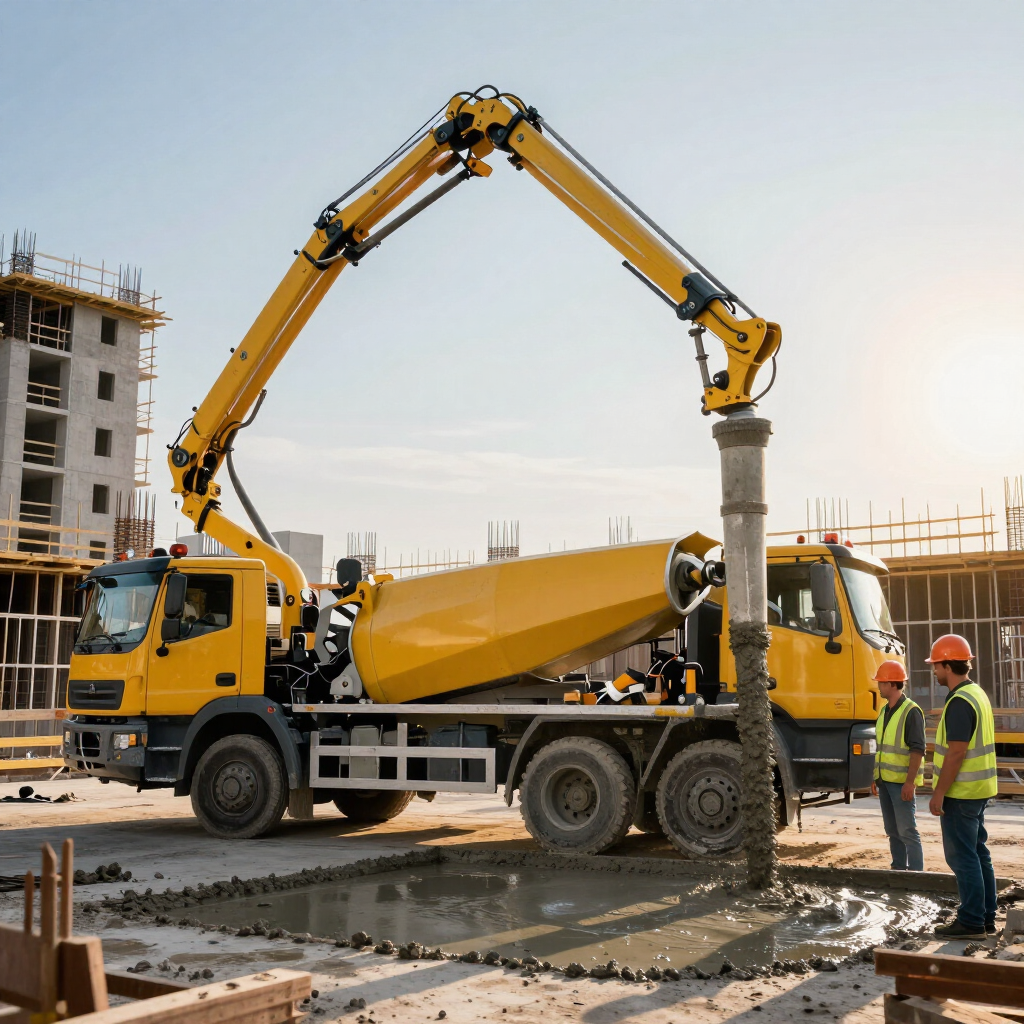
A boom pump mounts on a truck and features a remote-controlled, articulating arm (the "boom") that unfolds to reach heights, distances, and angles that no other equipment can match. Our fleet includes a 36 Meter Putzmeister Boom Truck and an Alliance 38-meter, five-section boom truck — giving us over 100 feet of reach from a single, stable setup point. Boom pumping is the go-to choice for large foundations, elevated slabs, high-rise work, and any project where the pour point is far from where a truck can safely park.
Line Pumping
A line pump uses flexible hoses connected to a stationary pump unit to move concrete horizontally or vertically over long distances. Line pumping excels on smaller residential jobs — think sidewalks, patios, crawl space floors, and tight-access pours. If your project has a complicated layout or a narrow gate the boom truck can't swing over, line pumping may be the right tool.
The Real-World Benefits of Concrete Pumping
Access Without Disruption
This is the benefit Maryland homeowners feel most directly. Our boom trucks can park on the street or driveway and pump concrete all the way around a house, over a fence, or down into a deep excavation — without ever driving a heavy mixer onto your lawn. That means no ruts, no torn-up landscaping, and no mud tracked onto the road after the job.
Faster Pours, Fewer Cold Joints
Concrete pumping allows for a continuous, uninterrupted pour. That matters because when a large pour is broken up into separate loads placed at different times, the earlier concrete can begin to set before the next load arrives — creating a "cold joint," which is a weak plane in the finished structure. With pumping, we move concrete from the truck to the form rapidly and consistently, dramatically reducing the risk of cold joints and producing a stronger finished product.
Reduced Labor and Better Precision
Traditional bucket-and-wheelbarrow work requires a large crew moving heavy loads repeatedly across a job site. Pumping eliminates most of that manual transport. The operator controls placement from the end of the hose or boom, guiding concrete exactly where it needs to go. Less labor movement means fewer opportunities for errors and a more precise pour overall.
Consistent Mix Quality
Every time concrete is transferred — from truck to wheelbarrow to form — there's an opportunity for the mix to lose water, pick up debris, or become unevenly distributed. Pumping delivers concrete from the ready-mix truck to the form in one continuous path, preserving the integrity of the mix and ensuring the water-to-cement ratio stays consistent from start to finish.
What Types of Projects Benefit from Concrete Pumping?
We use pumping on a wide range of residential and commercial projects across Maryland. Common applications include:
- Basement and foundation walls — especially when excavation depth makes direct chuting impossible
- Crawl space floors — low clearance makes wheelbarrow access impractical
- Driveways and flatwork — large surface areas benefit from rapid, even distribution
- Retaining walls — terrain and elevation changes make traditional placement difficult
- Swimming pools and gunite applications — specialized pumps spray concrete onto curved forms with uniform thickness
- Slabs on grade — residential and commercial floors where speed and level distribution are critical
- Hard-to-access backyard pours — our boom trucks reach far beyond what mixer trucks can physically access
Shotcrete and Gunite: A Specialized Pumping Application
For projects involving retaining walls, pool shells, and tunnel or slope stabilization, we also offer shotcrete and gunite services. These techniques use specialized pumps and nozzles to spray concrete at high velocity directly onto a prepared surface. The impact compacts the material as it lands, creating a dense, durable layer that bonds tightly to the substrate. This method is particularly valuable for irregular shapes or vertical surfaces where form-and-pour techniques would be cumbersome.
Concrete Pumping Across Southern Maryland
Concrete Walls Inc. serves job sites throughout the region, including Calvert County, Charles County, St. Mary's County, Prince George's County, and Anne Arundel County. Maryland's varied terrain — from waterfront properties with saturated soils to wooded lots with limited drive access — makes pumping equipment essential rather than optional on many projects. Our team understands the site conditions common across Southern Maryland and brings the right equipment setup for each job.
Whether you're building a new foundation in Huntingtown, pouring a driveway in Dunkirk, or finishing a basement floor in Waldorf, our pumping services are designed to get concrete placed efficiently with minimal impact on your property.
How to Schedule Concrete Pumping with Concrete Walls Inc.
The earlier you bring us into the planning process, the better. Knowing your site layout, soil conditions, access points, and pour volume in advance lets us select the right equipment — boom or line pump, which truck, how much hose — before we ever show up on site. A short pre-planning conversation can prevent costly surprises on pour day.
To get started, call us at 301-855-0170 or 410-610-9627. You can also learn more about our concrete pumping services and the specialized equipment we operate, or visit our contact page to request a quote for your project.
Frequently Asked Questions: Concrete Pumping
Will a pump truck damage my driveway or yard?
In most cases, no. Because our boom trucks can park in one fixed location and use their long reach to deliver concrete, the heavy vehicle stays on firm pavement while the boom arm does the work. Your lawn, landscaping, and driveway are protected from the rutting and compaction that comes with mixer trucks repeatedly crossing soft ground.
Is concrete pumping worth it for a small residential job?
Often, yes. Even on smaller pours, pumping saves labor time and protects your property. For crawl space floors, tight-access patios, or any pour location more than a short wheelbarrow run from the street, pumping is usually faster and more cost-effective once you factor in total labor hours.
How far can the boom truck reach?
Our 36-meter and 38-meter boom trucks provide over 100 feet of horizontal and vertical reach from a single setup position. This covers the vast majority of residential lots and most commercial sites.
Do you coordinate with the ready-mix supplier?
Yes. Our team works alongside the concrete supplier to ensure trucks arrive on a schedule that keeps the pump running continuously. Proper staging prevents downtime and reduces the risk of cold joints in large pours.
Can pumping be used for both interior and exterior pours?
Absolutely. Pumping is equally suited for interior applications like basement floors and crawl spaces as it is for exterior work like driveways, footings, and retaining walls.