What You Need To Know About Concrete Retaining Walls In Maryland
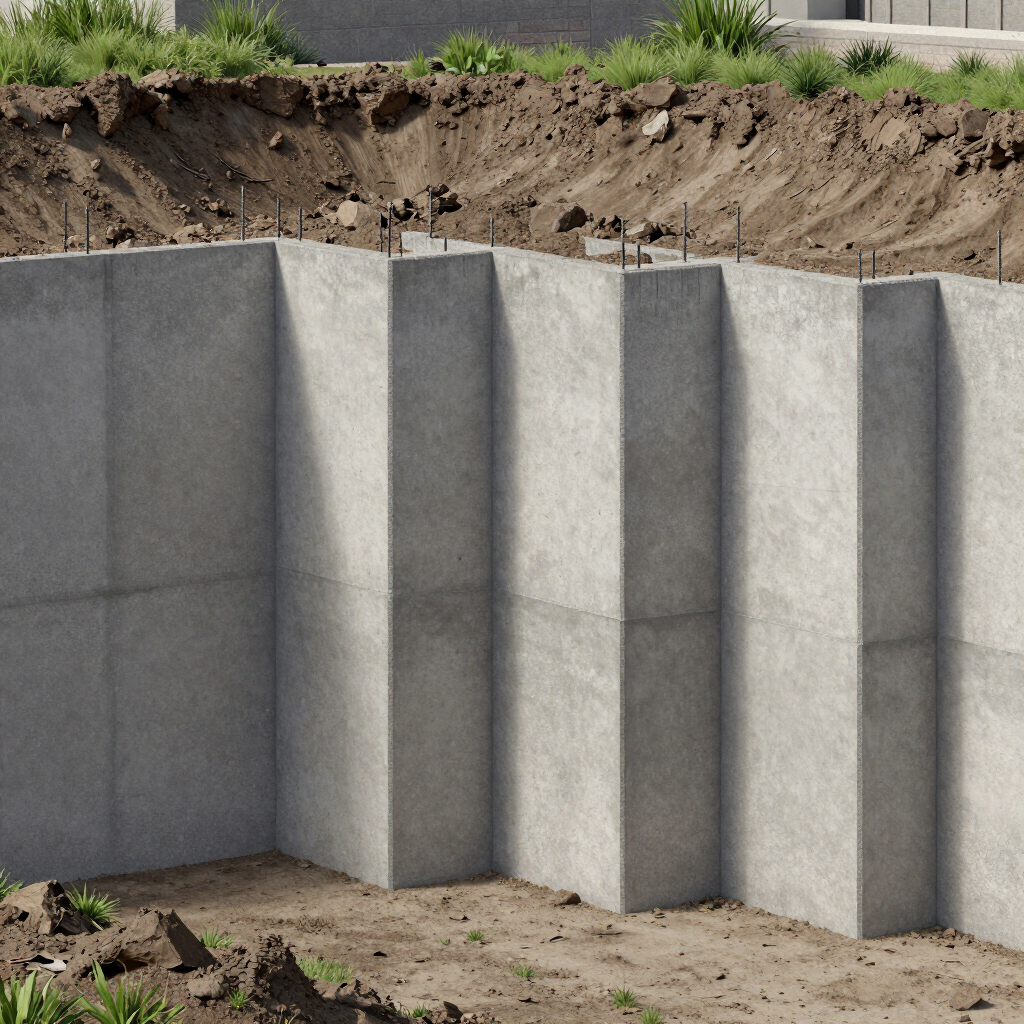
Concrete Retaining Walls in Maryland: What You Need to Know Before You Build
Slopes erode. Soil shifts. Heavy rain turns a gentle grade into a slow-moving problem that eats away at your yard, undermines your driveway, and deposits sediment where you don't want it. If your property has any significant elevation change — even a modest one — a retaining wall isn't just a landscaping upgrade. It's a structural solution that protects the ground beneath your home, your hardscaping, and your investment.
At Concrete Walls Inc., we build retaining walls throughout Southern Maryland that are engineered to hold, designed to last, and sized for the actual forces at work on your site. Here's what property owners in Calvert, Charles, St. Mary's, Prince George's, and Anne Arundel Counties should understand about concrete retaining walls before a project gets underway.
What Does a Retaining Wall Actually Do?
A retaining wall holds back a mass of soil that would otherwise shift downhill under the force of gravity, water, and the weight of whatever sits above it — a lawn, a structure, a driveway, or a garden bed. Without the wall, that soil moves. Sometimes slowly through gradual erosion; sometimes suddenly through a slope failure. Either way, the consequences compound over time.
In Maryland, the problem is intensified by the region's clay-heavy soils, which absorb water and expand during wet seasons, then dry and crack in summer heat. That constant cycle of swelling and shrinking puts enormous lateral pressure on any structure meant to hold soil in place. A properly engineered concrete retaining wall is built to absorb and redirect that pressure — not just stand in front of it.
Gravity Walls vs. Reinforced Retaining Walls
Not every retaining wall project is the same, and the type of wall you need depends primarily on how much soil you're holding back and how high the wall needs to be.
Gravity Retaining Walls
A gravity wall uses its own mass and weight to resist the lateral pressure of the soil behind it. These walls are generally shorter — suited for modest grade changes, raised garden beds, landscape terracing, and erosion control along a gentle slope. Because the design relies on the collective weight of the individual blocks, the installation can be more straightforward, and shorter gravity walls may not require extensive soil testing or engineering review. That said, site conditions still matter, and even a gravity wall needs a properly prepared base to perform correctly over time.
Reinforced Retaining Walls
When you're holding back significant volumes of soil — or when the wall needs to reach heights of several feet or more — a reinforced wall is the right solution. Reinforced retaining walls incorporate additional structural elements beyond the blocks themselves to manage the enormous pressure that large soil masses exert. These walls can reach up to forty feet in height depending on application, and they require professional installation along with thorough soil testing to ensure the design is appropriate for your specific site conditions. This is not a project where guessing is acceptable.
Our team evaluates each site individually to determine which wall type fits the terrain, the load, and the long-term performance requirements of the project. You can learn more about our concrete retaining wall services and the approach we take to each project.
The Anchor Retaining Wall System
One of the most proven and widely used retaining wall product lines in the industry is the Anchor Retaining Wall System. Anchor has developed an extensive range of wall styles, block profiles, and material options specifically engineered for performance under real-world soil pressure conditions.
Anchor's products are built from high-quality materials including aspen, Hampton, and Highland stones — all manufactured to the dimensional tolerances that structural retaining wall applications demand. Beyond raw strength, Anchor has invested heavily in the engineering side: their wall systems are designed through advanced structural principles so that the assembled wall resists the sheer weight and lateral force of the soil behind it without relying on luck or oversizing.
For homeowners, the Anchor system also offers something most structural products don't: genuine aesthetic variety. Anchor wall products come in a wide range of colors, textures, and patterns, so the finished wall integrates naturally with your home's exterior and existing landscaping rather than standing out as purely utilitarian infrastructure. Whether you're creating a tiered garden, defining a driveway edge, or stabilizing a steep backyard grade, there's an Anchor product profile that fits the visual context of your property.
Visit our Anchor Retaining Wall Systems page for a closer look at the product line and how these walls are engineered for Maryland's demanding soil and climate conditions.
Why Concrete Outperforms Other Retaining Wall Materials
Timber, treated wood, and interlocking plastic systems are all marketed as retaining wall options. For very small, low-stakes applications, some of them work adequately. But for anything that needs to perform over decades — holding real soil loads through Maryland winters, wet springs, and humid summers — concrete is the material that actually delivers.
Here's why the comparison isn't close:
- Strength: Poured concrete walls offer compressive and flexural strength several times that of concrete block alternatives, and far beyond the minimum safety factors required by code. Timber and landscape timbers simply cannot match that load capacity.
- Water resistance: The density and joint-free construction of poured concrete walls dramatically reduces water infiltration. Wood rots. Timber walls absorb moisture, swell, and fail over time — often within a decade in wet climates like Southern Maryland's.
- Fire resistance: Solid concrete wall construction provides at least twice the fire protection of hollow-core concrete block, and far more than any wood-based system.
- Design flexibility: Concrete construction adapts to most site geometries and grade configurations. Finishes can be smooth or textured, and Anchor block systems offer extensive color and pattern options that give you design control over the finished appearance.
- Maintenance: A properly installed concrete retaining wall is virtually maintenance-free. No annual sealing, no rot treatment, no replacing failed timbers. You build it once and it holds.
For a full breakdown of how poured concrete walls compare across these categories, see our page on the benefits of concrete walls.
Where Retaining Walls Are Used on Maryland Properties
Retaining walls solve a wide range of site problems beyond basic slope stabilization. Common applications we handle across Southern Maryland include:
- Erosion control along slopes and embankments — preventing topsoil loss on grades that drain toward the house or a neighboring property
- Driveway and road edge retention — stabilizing the soil bank alongside a cut driveway where the grade drops sharply
- Terraced yard and garden beds — converting an unusable sloped yard into level, functional outdoor living space
- Foundation protection — keeping soil pressure away from basement walls and footings on sloped lots
- Water garden and landscape feature borders — using lower retaining walls as structural frames for decorative garden elements
- Commercial and civil applications — larger reinforced walls for parking areas, road cuts, and commercial site development
What to Expect from the Installation Process
A retaining wall is only as good as the preparation that goes into it. Skipping steps — inadequate base compaction, improper drainage behind the wall, wrong block selection for the load — leads to walls that lean, crack, or fail within a few years. Here's how a properly executed retaining wall project unfolds:
Site Assessment and Soil Testing
Before any blocks are set, we evaluate the site. For reinforced walls and any project involving significant soil loads, soil testing is essential. The composition, density, and moisture behavior of the soil determines how much lateral pressure the wall will need to resist. Skipping this step and guessing at the design is a risk no competent contractor should take with a structural installation.
Excavation and Base Preparation
The wall's foundation determines its long-term performance. We excavate to the appropriate depth, compact the base material, and ensure proper grade so the wall starts level and remains stable as the soil behind it shifts seasonally.
Drainage
Hydrostatic pressure — the pressure that builds up when water saturates the soil behind a wall — is one of the leading causes of retaining wall failure. Proper drainage behind the wall relieves that pressure before it builds to damaging levels. Drainage aggregate, filter fabric, and drain pipe placement are all part of a correctly installed system.
Wall Construction and Backfill
Once the base is set and drainage is in place, wall construction proceeds course by course. Backfill is placed and compacted in lifts as the wall rises, not all at once after the wall is complete. This staged approach prevents overstressing the wall before it's fully built.
Retaining Wall Services Across Southern Maryland
Concrete Walls Inc. builds retaining walls for residential and commercial clients throughout the region, including Calvert County, Charles County, St. Mary's County, Prince George's County, and Anne Arundel County. Whether the project is a modest landscape terrace in Huntingtown or a large reinforced wall for a commercial site in Waldorf, we bring the same attention to engineering, materials, and installation quality.
To discuss your site and get a quote, call us at 301-855-0170 or 410-610-9627. We're happy to walk through the site conditions, wall options, and what the right solution looks like for your specific property.
Frequently Asked Questions: Concrete Retaining Walls in Maryland
How do I know if I need a retaining wall or just regrading?
Regrading adjusts the slope of your yard to redirect water flow and can address minor erosion issues. When the grade change is significant, the soil is actively shifting, or you need to create a level area on a sloped lot, a retaining wall is the structural solution. We can assess your site and recommend the right approach.
Do retaining walls require a permit in Maryland?
Permit requirements vary by county and by wall height. In most Maryland jurisdictions, walls above a certain height — often four feet, measured from the base — require a permit and an engineered design. We're familiar with local requirements across our service area and can guide you through that process.
How long does a concrete retaining wall last?
A properly installed concrete retaining wall is designed to last for decades with virtually no maintenance. The material itself doesn't rot, rust, or degrade under typical soil and weather conditions. Longevity depends on correct installation — specifically drainage and base preparation — more than anything else.
Can a retaining wall improve my property's usable space?
Absolutely. Terracing a sloped yard with a series of retaining walls can convert ground that's currently too steep to use into level outdoor living areas — patios, garden beds, play areas, or parking pads. It's one of the most effective ways to add functional square footage to a property with challenging topography.
What's the difference between decorative and structural retaining walls?
A decorative wall is primarily aesthetic — a low border around a flower bed, for example — and isn't engineered to resist significant soil pressure. A structural retaining wall is designed and built to resist the lateral force of the soil behind it. The two categories have very different design requirements, and a wall that looks like a retaining wall but isn't engineered as one can fail without warning.
The body content of your post goes here. To edit this text, click on it and delete this default text and start typing your own or paste your own from a different source.