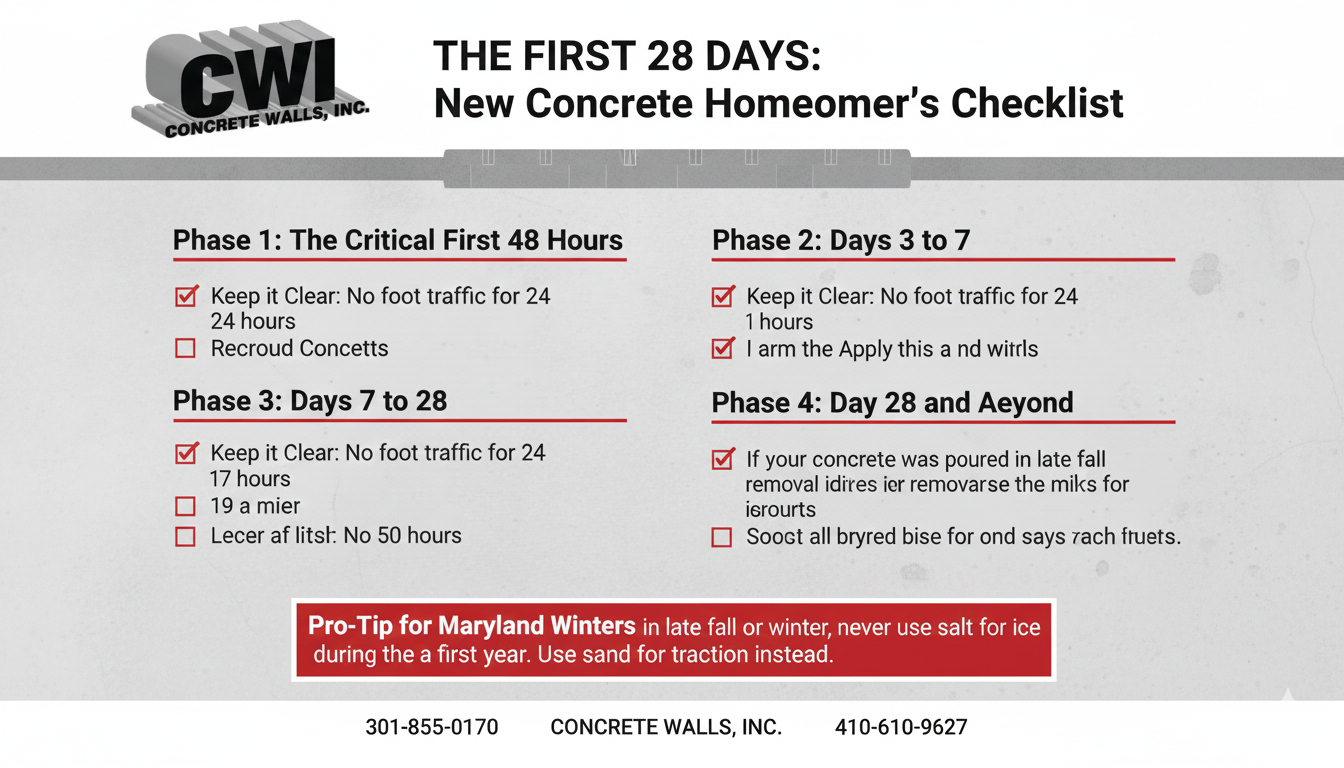
The First 28 Days: A Homeowner’s Maintenance Checklist
This checklist is designed to help homeowners protect their investment during the critical
28-day hydration period. Following these steps will ensure the concrete achieves maximum structural strength and a beautiful finish.
Phase 1: The Critical First 48 Hours (Initial Set)
- [ ] Keep it Clear: Strictly no foot traffic or pet traffic for at least 24 hours. Concrete is still "green" and susceptible to permanent footprints or indentations.
- [ ]
Watch the Edges: Do not step on the edges of the slab, as they are the most fragile parts and can break or "spall" easily.
- [ ]
Keep Sprinklers Off: Unless instructed otherwise by our crew for moist-curing, keep automated sprinklers off to prevent "pitting" the surface while it is still soft.
Phase 2: Days 3 to 7 (Strength Building)
- [ ] The "7-Day Soak": If a curing compound wasn't applied, spray your concrete with a garden hose 5–10 times a day. Keeping the surface damp allows the chemical reaction (hydration) to continue, making the concrete significantly stronger.
- [ ]
Light Foot Traffic: You can now walk on the surface, but avoid dragging heavy furniture, toolboxes, or sharp objects across it.
- [ ]
Avoid Tape/Coverings: Do not place plastic sheeting, rugs, or tape on the concrete. This can trap moisture unevenly and cause permanent blotching or "mottling" of the color.
Phase 3: Days 7 to 28 (The Curing Window)
- [ ] Parking Restrictions: You may drive standard passenger vehicles on the concrete after day 7, but do not park near the edges.
- [ ]
No Heavy Loads: Keep heavy delivery trucks, dumpsters, or construction equipment off the slab entirely until the full 28 days have passed.
- [ ]
Keep it Clean: Avoid letting wet leaves, fertilizer, or grass clippings sit on the new concrete. These contain tannins and chemicals that can cause permanent organic staining on a new surface.
- [ ]
No Chemicals: Strictly avoid using de-icing salts or harsh chemical cleaners during this window.
Phase 4: Day 28 and Beyond (Long-Term Protection)
- [ ] Final Inspection: Check the control joints (the "lines" cut into the concrete) to ensure they are clear of debris.
- [ ]
Schedule Sealing: Now that the concrete has reached its full strength and released its internal moisture, it is the perfect time to apply a high-quality sealer to protect against oil, salt, and weather.
Concrete Pro-Tip for Maryland Winters
If your concrete was poured in late fall or winter,
never use salt for ice removal during the first year. Use sand for traction instead. New concrete is highly sensitive to the freeze-thaw cycles accelerated by salt.
Learn about concrete foundation services and installation